


BeatAPI
One API key for AI models, 1,000+ data APIs, and workflows
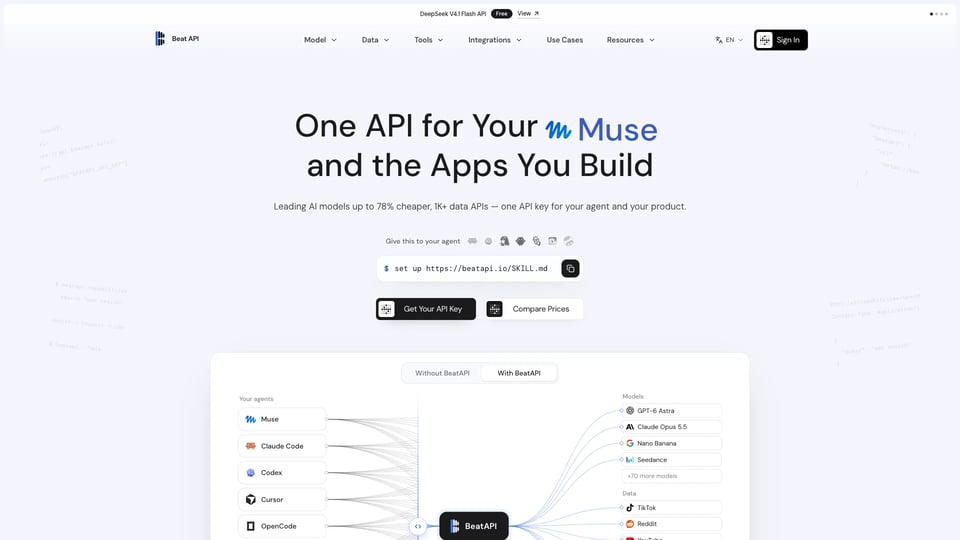
About BeatAPI
BeatAPI gives AI agents and applications access to the models, data, and tools they need to complete practical tasks. Rather than integrating separate services for language models, image generation, video creation, social media research, and web search, developers can access supported capabilities through one platform.
Built for developers, independent founders, content teams, and businesses building AI-powered products, BeatAPI brings model execution and external information retrieval into the same development workflow. Applications can call its APIs directly, while compatible AI agents can discover and use capabilities through MCP.
Its purpose goes beyond forwarding prompts to a language model: BeatAPI helps connect the steps between finding information, reasoning about it, and producing useful outputs. Product overview (https://beatapi.io/)
Core Features
1. Unified Access to AI Models
BeatAPI provides access to text, image, and video models through a single account. Supported model families include GPT, Claude, Gemini, DeepSeek, Qwen, Grok, and others, with availability and supported features documented for each model.
Text integrations support OpenAI Chat Completions, OpenAI Responses, Anthropic Messages, and Gemini-native request formats, depending on the selected model family. This allows developers to retain familiar SDKs and request patterns rather than rebuilding their applications around a proprietary interface.
Text models support streaming responses. Model-specific documentation helps developers check capabilities such as image input, tool calling, context limits, and output limits before integrating. Text API documentation (https://docs.beatapi.io/text-api)
2. Image, Video, and Media Workflows
Developers can use BeatAPI to integrate image generation and editing, video generation, and supported media workflows into their products. Available workflow categories include music videos, ecommerce videos, and video analysis.
Image, video, and workflow operations use asynchronous tasks where appropriate, allowing applications to submit a request and retrieve its status and result. Capabilities and inputs vary by model, so developers can select the model and specification that fit a particular creative task.
These capabilities support applications such as product-image tools, advertising creative generators, video-production assistants, and AI-powered content platforms. Model and workflow overview (https://docs.beatapi.io/faq/models-capabilities)
3. Public Social Media Data
BeatAPI provides access to supported public data from platforms including X, Reddit, TikTok, Instagram, YouTube, LinkedIn, Threads, Xiaohongshu, and Douyin.
Depending on the platform and action, applications can search content, retrieve public profiles, inspect posts and videos, and read comments or supported replies. Results can feed into research pipelines, creator-discovery tools, customer-feedback analysis, and content-planning workflows.
The service supplies data for analysis rather than managing social accounts or publishing posts. Available fields, pagination, and access requirements follow each action’s documented contract. Request identifiers and source identifiers help developers retain context and trace individual lookups. Social Data API (https://beatapi.io/data)
4. Web Search and Research Tools
BeatAPI offers four complementary web capabilities: Search, Read, Map, and Research.
Search finds relevant results; Read retrieves page content as Markdown or plain text; Map discovers pages within a website; and Research investigates a question across multiple sources and returns findings with supporting sources.
Developers can combine these tools to build research assistants, source-backed reports, market-monitoring workflows, and applications that need information beyond a model’s training data. Supported search types also include news, images, videos, scholarly content, and other specialized categories. Web tools documentation (https://docs.beatapi.io/web-search)
5. Agent-Friendly Capability Discovery
BeatAPI organizes supported capabilities around a three-step process: Search → Inspect → Run.
An agent first searches for a relevant capability, then inspects its required inputs, price, and execution readiness before running it. This makes it possible to discover capabilities as needed instead of loading an entire catalog into the agent’s working context.
The same pattern is available through REST and MCP. Discovery and inspection are free; execution requires authentication and is billed according to the selected capability. Responses include guidance for the next operation, helping agents handle both immediate results and asynchronous tasks. Capabilities API (https://docs.beatapi.io/capabilities)
6. Integrations With Existing Developer Tools
BeatAPI provides integration guides for tools such as Claude Code, Codex CLI, Gemini CLI, Cursor, Cline, Cherry Studio, Chatbox, and AnythingLLM.
It also documents integration paths for automation and application-building platforms including n8n, Dify, Zapier, and Make. Developers can choose between model-provider configuration, direct HTTP requests, and supported MCP connections according to their tool and use case.
These options make BeatAPI suitable for both custom software development and workflows assembled within existing AI tools. Integration guides (https://docs.beatapi.io/integrations)
Pricing and Billing
BeatAPI uses prepaid, usage-based billing with a shared USD balance. Pricing depends on the selected model, data action, tool, or workflow.
Its pricing page publishes model rates and comparisons for specific configurations, allowing developers to evaluate costs before integrating. Capability inspection exposes the applicable pricing information before execution. Free models and introductory credits may be available under the current published policy; paid capabilities are charged according to usage. Current pricing (https://beatapi.io/pricing)
Who Is BeatAPI For?
- AI application developers building products that combine model inference, external data, and tool execution.
- Agent developers connecting assistants to discoverable research and creation capabilities.
- Independent founders and SaaS teams reducing the work of integrating and maintaining multiple services.
- Content and creative teams building image, video, and research-assisted production workflows.
- Marketing and research teams organizing public discussions, creator profiles, comments, and web sources.
- Automation builders connecting supported capabilities to repeatable business workflows.
What Makes It Different?
BeatAPI combines model access with public social data, web tools, and media workflows rather than focusing only on language-model routing. Its agent-facing discovery process lets an assistant check what a capability does, what inputs it needs, and what it costs before execution.
The result is a common access layer for developers who want their AI systems to do more than generate text: retrieve relevant information, analyze source material, create media, and connect those steps within an application.
Suggested Categories
AI Developer Tools, AI Infrastructure, API Platforms, AI Agents, MCP Tools, Large Language Models, Image Generation APIs, Video Generation APIs, Social Media Data, Web Research, Workflow Automation.
Alternatives to BeatAPI
Other products in the registry that share tags or a category with BeatAPI.

Social data APIs for AI agents – no signup needed.

OfoxAI — One API key for 100+ LLMs. OpenAI-compatible, enterprise-ready, zero markup.

Discover, Compare, and Choose the Best AI Agent Tools

The developer-friendly API for structured Amazon data.

AI API

Orchestrate coding agents with durable memory and validated results
Shipped the same week
Products that launched on Shipstry in the same ship week as BeatAPI. See everything that shipped this week.
 oolong docAI Canvas Agent for co-creating diagrams, pitch decks, resumes & visual docs with AI.
 Nano AI MakerCreate AI videos from text or images, generate visuals, and edit photos with Nano AI Maker.
 Flux 3Explore FLUX 3 AI image and video creation, multimodal capabilities, and model updates in one place.
 Story2BoardStory2Board is a purpose-built AI storyboard agent for film and video pre-production.
 SpicyAPIImage, video, audio and chat APIs with prepaid USD usage billing.
 SeedRouterSeedRouter: one API for every model your product needs
 PopNowCreate images, videos, music and voiceovers in one studio
 OpenLaunchA fresh drop of handpicked product launches, every week.
Comments